


|
|
The Man Behind the World's Most Famous
Collar |
|
|
|
|
click here to return to publicity page
|
|
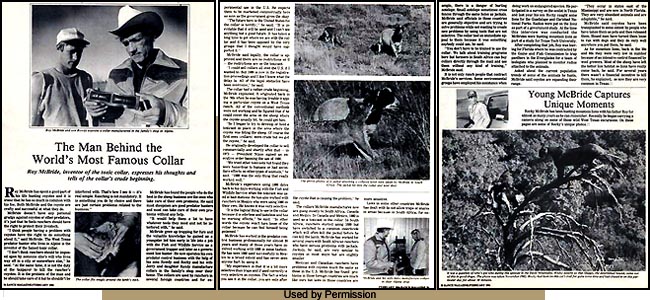
The Man Behind the World’s Most Famous
Collar Roy McBride, inventor of the
Toxic collar, expresses his thoughts and tells of the collar’s crude
beginning. Roy McBride has spent a good part of his life hunting coyotes and it is ironic that he has so much in common with his foe. Both McBride and the coyote are crafty and successful at what they do. McBride doesn’t have any personal grudge against coyotes or other predators, it’s just that he feels ranchers should have the right to protect their livestock.
“I think people having a problem with coyotes have the right
to do something about it,” said McBride. The “I don’t think ranchers should be imposed upon by someone else’s will who lives way off in a city or somewhere else,” he said. “At the same time, it is not the duty of the taxpayer to kill the rancher’s coyotes. It is the problem of the man and he should take care of it but he shouldn’t be interfered with. That’s how I see it—it’s real simple. Ranching is not mandatory. It is something you do by choice and there are just certain problems related to the business.” McBride has found the people who do the best in the sheep business are the ones who take care of their own problems. He said most sheepmen are good predator hunters and most can take care of their own problems without any help. “It would help them a lot to have whatever tools they need and not be interfered with,” he said.
McBride grew up trapping for furs and the valuable knowledge
he gained as a youngster led him early in life into a job with the
Fish and Wildlife Service as a government trapper and later as a
government lion hunter. He now operates his own predator control
business with the help of his sons Rowdy and Rocky, and his wife
Jerry and daughter Randy manufacture collars in the family’s shop
near their home. The collars are used by ranchers in several foreign
countries and for experimental use in the
“The future here in the McBride said legally, the collar is approved and there are no restrictions on it—the restrictions are on the toxicant.
“I could sell collars all over the
“The collar had a rather crude beginning, McBride explained.
It originated back in the ‘60s when he was having trouble trapping a
particular coyote on a “So I began to try to develop or hold a toxicant in place in the area where the coyote was biting the sheep. Of course the first ones (collars) were crude, but we got the coyote,” he said. He originally developed the collar to sell commercially and shortly after that—in 1972—President Nixon signed an executive order banning the use of 1080. “We tried other toxicants but found they were hazardous to humans or has secondary effects on other types of animals,” he said. “1080 was the only thing that really worked well.”
McBride’s experience using 1080 dates back to his days
working with the Fish and Wildlife Service when the toxicant was
used in bait stations. He has also worked with ranchers in
“It is the logical thing to use in the collar because it is odorless and tasteless and has no warning effects,” he said. “In other words the coyote won’t turn loose of the collar because he can feel himself being poisoned.”
McBride has worked in the predator control business
professionally for almost 30 years and many of those years have
involved working with 1080 in some fashion. He has seen 1080 used
successfully in
“My experience is that it is a lot more selective than traps and if used correctly is very selective on coyotes. The fact is when you use it in the collar, you are only after the coyote that is causing the problem,” he said.
The collars McBride manufactures now are going mostly to
Mexican and Canadian ranchers have problems with coyotes much the same as those in the U.S. McBride has found problems in those foreign countries are much like ours but laws in those countries are more sensitive. Laws in some other
countries McBride has dealt with do not allow traps or snares in
areas because in “You don’t have to
be trained to use the collar. We talk about training programs here
but farmers in It is not only ranch
people that contract McBride’s services. Some environmental groups
have employed his assistance when doing work on endangered species.
He participated in a survey on the ocelot in
After completing
that job, Asked about the current population trends of some of the animals he hunts, McBride said coyotes are expanding their range. “They occur in
states east of the
McBride said coyotes have been transplanted to some extent by people who have taken them as pets and then released them. Hound men have turned them loose to run with dogs and they do very well anywhere you put them, he said. As for mountain
lions, back in the 50s and the 60s they were very low in number
because of an intensive control financed by wool growers. Most of
the sheep have left the better lion habitat, so lions have really
come back, he said. For several years there wasn’t a financial
incentive to kill them, he explained, so now they are very common in
|